

Fleming College helps map monarch migration route
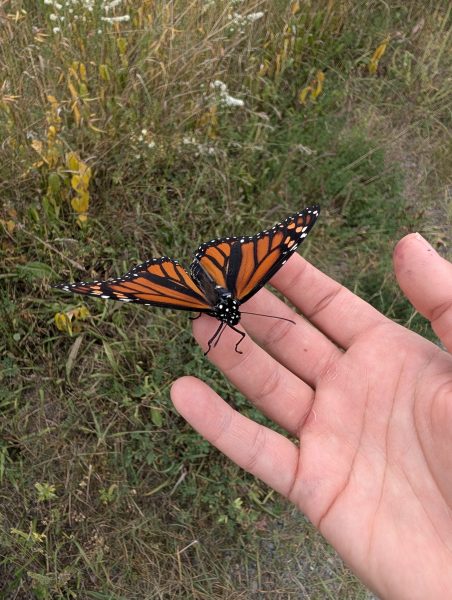
New technology is being used to track the migration pattern of monarch butterflies, and Fleming College’s Frost Campus, located in Lindsay, is one of 25 research groups taking part in Project Monarch.
Erin McGauley, a professor in the school of environmental and natural resource sciences, read about ultralight BlūMorpho solar transmitters last year. “As soon as it came out, I saw it and I wanted to get my students involved,” she said.

The college purchased some of the transmitters last year to be used in McGauley’s class.
With the traditional method of sticker tagging, it was known the monarchs would start their migration in Canada and end in Mexico. “These new tags that transmit as the monarchs are migrating, we can get real-time data. Now we have the full story of where they go, how fast they move, where they rest, what wind conditions they move in,” McGauley said.
Monarchs are a federally endangered species, and this data will help to figure out how to better protect them. They belong to the “super generation” of monarchs that live for eight or nine months instead of a few weeks, postponing reproduction to focus entirely on surviving the journey south.
Every ping on the map helps international conservation biologists fill critical knowledge gaps regarding butterfly migration pathways, population connectivity, stopover sites, and the impacts of weather and climate. The information generated through this data will directly inform recovery work for monarchs, proving that protecting them requires a connected chain of safe habitats with milkweed plants, gardens, and nectar sources stretching all the way across the continent.
McGauley has a special permit to be able to apply the transmitters onto the butterflies. With both the insect and transmitters (that weigh the same as a single grain of rice) being so small, she had to apply them using eyelash glue. To her, it was exciting and nerve-racking knowing she had to apply the transmitters in front of 26 students.
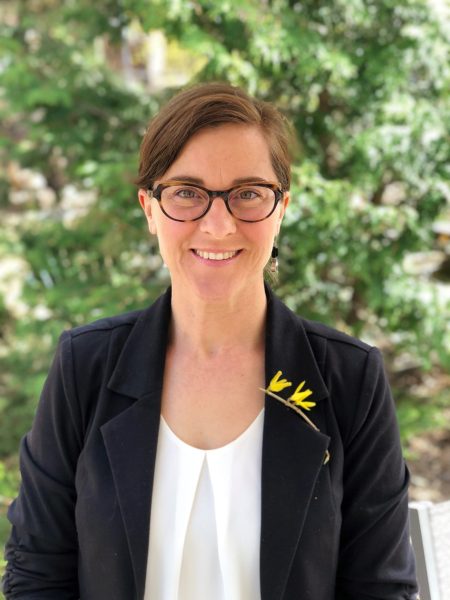
While her students weren’t able to apply the transmitters, McGauley made sure they were still involved. “I was trying to get (students) involved as much as I could, so I had them reading out the steps of the protocol, filing in the data sheets.” They also had to follow a strict tri-national protocol to ensure every step was followed.
Each student got to hold the two monarchs before they were released from the college’s pollinator garden. Now, the students are tracking Connie, named after the conservation biology program, and Sandy, named after Sir Sandford Fleming, as they go on their migration journey. “Right now, they’re chilling in Kansas and Missouri and Arkansas because it’s warmer, so they’re not doing these big southbound migration pushes.”
The pollinator garden provides an essential refueling stop for migrating monarchs, complete with native milkweed. McGauley encourages anyone who’s interested in helping make more habitats for the endangered species to simply take dry, brown pods and press the seeds directly into the ground after the first frost to ensure Connie and Sandy’s offspring have a safe place to lay eggs in summer 2027.
McGauley said the students, and herself, have been connected to the butterflies. If they don’t get an updated ping for a couple of days, they get worried about the monarchs.
If the college can fit it into their budget, McGauley would like to make the monarch tracking a regular project in her class. “I’d like to include a few more next year. It’s been such a successful project and it certainty generated a lot of interest so I’d love to connect more students with this, and if we can do it on a yearly basis and keep contributing to the research, that would be fantastic.”
Anyone can track Connie and Sandy using the Project Monarch app or going to projectmonarch.org.


Wonderful news. I am now tracking Connie and Sandy. We live just north of Lindsay and saw literally hundreds of monarchs over a week in September, mostly flying west. Usually we might see a dozen, so this was very encouraging. Keep up the great work SSFC and Advocate!
This is very cool and with the app you can follow their journey south. Well done Fleming College..