
Kawartha Lakes Secures $9 million in rural support funding
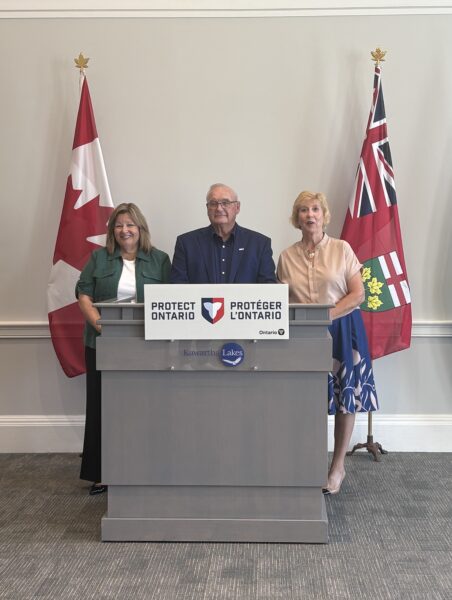
Kawartha Lakes will be receiving close to $9 million through the provincial government’s Ontario Municipal Partnership Fund to help support critical services such as road maintenance and public transit in the city.
Funding for Kawartha Lakes will be $8,902,700, which is an increase of $537,500, and across the province more than $87 million is being used to help support services across 77 communities.

“This funding will support critical services and infrastructure throughout the communities in Kawartha Lakes, and it is a testament of our government’s commitment to protecting rural Ontario communities,” said Laurie Scott, MPP Haliburton-Kawartha Lakes-Brock.
Minister of Rural Affairs, Lisa Thompson said that the government wants to better support rural communities. “We want to turn our communities into the kind of places where people want to live, work, and most importantly call home and raise a family,” she said.
The provincial government has also established a strategy called enabling opportunity, which aims to make sure different issues are looked at from a rural point of view. “We can better champion the voices of rural leaders, and help ensure our small towns and our small communities have the tools to leverage economic opportunities and address local priorities.”
Mayor Doug Elmslie said the new funding is important with how fast Kawartha Lakes is growing. “Our city is growing, and our infrastructure needs are growing along with it. We have a significant capital project planned for the next five to 10 years that will greatly improve day-to-day life here for our residents, businesses and visitors.”
The goal for the city is to make sure the correct infrastructure is in place before the population grows too fast to keep up with. “From bridges to water treatment plants, we are investing heavily in major builds and upgrades that will benefit our communities for years and decades to come,” said Elmslie.
Thompson said that rural communities, like Kawartha Lakes, are where more and more people are choosing to settle down, as opposed to big cities. “That money is going to community initiatives, and at the end of the day it’s going to make Kawartha Lakes and surrounding communities that much stronger and desirable for people to work, build a business, and most importantly, be proud to call home.”



This is good news.
The additional provincial funding is certainly welcome, but it’s important to keep it in perspective.
The headline highlights “$9 million,” which sounds substantial until you compare it to Kawartha Lakes’ finances as a whole. The City’s 2026 budget is approximately $472 million, meaning this funding represents only about 2% of the total budget. While every dollar helps, this is not enough to fund the major infrastructure projects referenced in the article. Those projects will still require significant municipal funding through property taxes, development charges, borrowing, and additional provincial and federal grants.
The Province deserves credit for increasing its support, but this announcement should be viewed as an incremental contribution to Kawartha Lakes’ ongoing financial needs, not as a solution to the City’s infrastructure challenges.
If Kawartha Lakes wants to keep future property tax increases under control, Council also needs to address the long-term cost of maintaining one of Ontario’s largest municipal road networks. That begins with collecting and publishing traffic data for every rural road and establishing objective criteria for reviewing service levels.
For example, Council should evaluate:
dead-end concession roads that serve only a handful of residences;
seasonal cottage roads that receive year-round maintenance;
lightly travelled gravel roads with very low Average Annual Daily Traffic (AADT);
duplicate parallel rural roads where nearby collector roads already provide adequate access.
These are the types of roads that municipalities commonly review when balancing service levels with affordability. Depending on the findings, options could include reduced maintenance standards, seasonal maintenance, or, where practical and following public consultation, road closures or transfers.
Roads represent one of the largest demands on Kawartha Lakes’ tax-supported budget and will continue to drive property tax pressures unless the City is prepared to align service levels with actual road use. Residents who choose to live on lightly travelled rural roads should expect service levels that reflect the realities of a rural municipality, not the standards appropriate for busy urban streets. That’s how scarce tax dollars can be directed where they benefit the greatest number of residents while keeping future tax increases in check.
Our urban neighbourhoods can support paved streets, sidewalks, streetlights, and higher maintenance standards because the tax base is concentrated along relatively short lengths of road. Each kilometre of urban street is supported by hundreds of homes and businesses, generating far more tax revenue per kilometre than is available on most rural roads.
By contrast, many rural roads serve only a handful of homes or farms spread over long distances. It simply isn’t financially sustainable to provide the same level of service on low-volume rural roads as on busy urban streets. If Kawartha Lakes is serious about keeping property taxes affordable, service levels must reflect how roads are actually used and the tax base available to support them. Equal treatment does not always mean identical service—it means delivering the right level of service for the function and use of each road.