Teaching abroad
Local woman returns home from China, amazed by tech and traditions
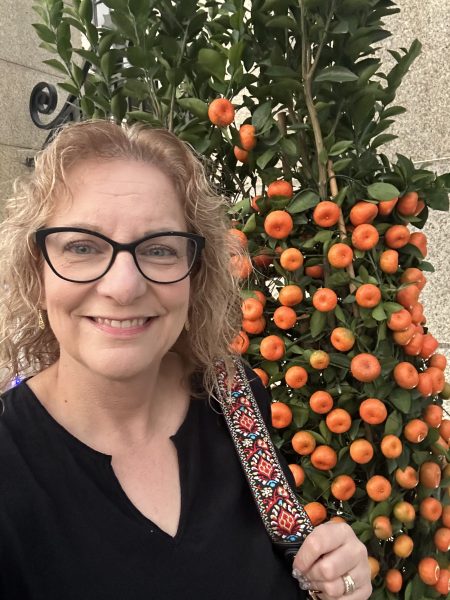
The first day Szabina Kitchen entered her apartment last year in Foshan China, where she would be living for the next 10 months, she was ready to pack her bags and return home to Lindsay. It was unfurnished and the bed felt like cardboard. Kitchen didn’t sleep a wink that first night.
She had quickly left her hometown where all her family and friends lived, to being in a foreign country where she didn’t know anyone or the language. However, this was all part of her dream; to teach in a different country.

Thankfully, a fellow teacher at the school took Kitchen, 57, under her wing. While Kitchen spent time furnishing her apartment, and getting a more comfortable bed, her co-worker let Kitchen stay with her and her family for a week.
After that, Kitchen said she never thought about leaving again.
After attending a job fair, she was offered a position to be an art teacher and librarian at a Canadian international school. It wasn’t run by the government, and students had to pay to attend the school, where the material is based off the Alberta curriculum.
“The first month was daunting. The first three days you’re jet lagged, and you don’t know anybody, and you have to trust people you don’t even know,” Kitchen said. Upon her arrival she was handed multiple documents that were written in Mandarin and was told to sign on the dotted line, all without knowing what exactly she was signing.
“The first four or five months I would come home from work, and I would be exhausted. A friend who had done teaching abroad explained to me ‘you are constantly taking in a new language, and new surroundings all the time, even when you’re not aware of it, and that is mentally exhausting,’” Kitchen said.
Teaching in another country brought a big learning curve for Kitchen. Some of the kids knew a lot of English, some knew a little, and some knew none. “Before I went, I would have said that my behaviour management was pretty bang on. When I got there, my behaviour management went out the window.” Students would be talking over her or leaving the classroom without asking for permission. They weren’t trying to misbehave, they simply didn’t understand her.
In homeroom classrooms, the international teachers have a learning partner, who acts as a translator. In the library and classes like art, the learning partners aren’t there. “I became even more dependent on my theatrical ability to act things out, lots of visual examples, and also relying on other students to help me out.”
During her time there, she took Mandarin lessons. She already spoke English, French, and German so she assumed picking up another language would be easy.
She quickly learned that Mandarin is a difficult language. One word can have multiple meanings, based on what letters you put an emphasis on. For example, dōng xī means east and west and dōng xi means objects, things, or stuff.
Kitchen also came to understand that Chinese languages focus on getting right to the point. In her Lindsay classroom, if another teacher wanted to borrow a hole puncher they would ask “can I please borrow your hole puncher?” In China, someone would instead simply say “give hole puncher,” not to be rude but to be efficient when speaking.
Next year will throw another learning curve her way, as the school is turning into an IB school. She’ll have to gear her teaching to specific units of study in the IB program, something she never did in Lindsay. For example, Grade 6 students will have a unit of study based on space, so in the library she’ll make sure the students are reading space books, and in art they’ll do projects based on the planets.
Aside from teaching, Kitchen was amazed at how much technology is used in the country. Purses and wallets aren’t needed, as everything is bought with your phone. One day Kitchen lost her laptop charger, and within 30 minutes of ordering a new one, it was at her door. “My front door opens with my fingerprints. I can get into the school with my face being scanned,” Kitchen said.
Kitchen went to a mall one day and the parking garages work almost like a ferris wheel. Large steel frames rotate vehicles in a continuous loops. When you drive in, you scan your phone, and your car becomes part of this rotation. When you come back you scan your phone again, and your car comes back down to the floor level.
“There’s other things that are still so traditional,” Kitchen said. When she would leave her building in the morning, a man would be sweeping the front walkway wearing a traditional cone straw hat and using a branch broom.
“Where I’m living there’s all these high rises, school and shops, but in between are farmer’s fields, and a river and people moving things with a wagon. They seem to really have a great respect for the past and keeping things that work, while at the same time moving forward,” Kitchen said.
She found that there was never a time she felt in danger while in Foshan, although she acknowledges that where she was staying doesn’t represent the entire country. “I think when it comes down to it, a country isn’t necessarily about its government or its politics, or what we see from the outside looking in. It’s about the people.”
Kitchen came home for the summer but is now gearing up to spend another year in China.
“It’s been amazing to come home and reconnect with my daughters and
husband, and my extended family and friends,” Kitchen said, noting that without their support she never would have taken the opportunity. “(My family) wrote me all these letters so I could open them throughout the year. They were extremely supportive, and my daughters in particular are very proud of me, and I feel good about giving them that example of it doesn’t matter how old you are, do you want to have an adventure? Go for it.”